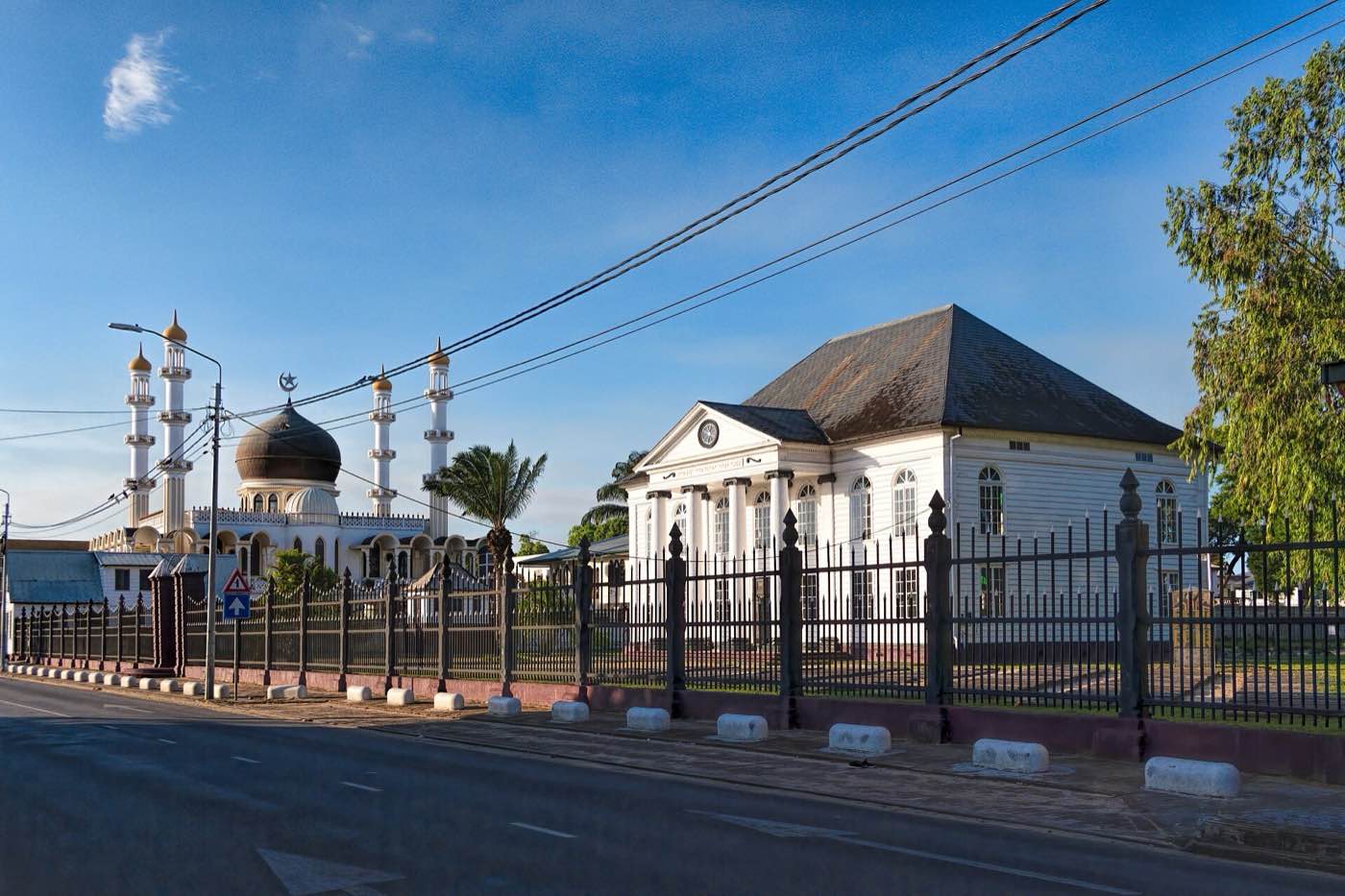
A synagogue on Keizerstraat in central Paramaribo whose congregation dates to 1665; it stands directly beside the Keizerstraat Mosque, a pairing often cited as a symbol of Suriname's religious coexistence.
Checked · 1 named source
Photo: Dan Lundberg, CC BY-SA 2.0, via Wikimedia Commons
Best for first-time visitors, architecture interest, cultural interest.
Neveh Shalom stands at Keizerstraat 82 in the historic inner city, and its congregation dates to 1665, making it one of the oldest Jewish congregations in the Americas.
It is best known for its neighbour. The Keizerstraat Mosque stands roughly seventy metres away on the same street, and the two buildings side by side are the image Suriname uses of itself: a country where four or five religious traditions arrived with different waves of migration and settled next to each other rather than apart.
Two things to hold carefully. The 1665 date is the founding of the congregation, not of the building you see. And the sand floor that appears in almost every guidebook description of Surinamese synagogues is not something we have been able to confirm from a source for this building. Nor are visiting hours, or whether the interior is open to visitors at all. Ask locally before assuming you can go in.
Two of Suriname's three World Heritage sites (the country's cultural pair), a plantation district, a ruined sugar factory and a fort museum. What each one holds, which guided walks and tours are published and at what price, and where slavery and indenture are the subject rather than a footnote.
A workable three-day plan: the UNESCO inner city on foot, a day across the river in Commewijne, and a third day that depends on what you want from Suriname.
A half-day route through the thirty hectares UNESCO inscribed in 2002: fort, square, palace, park, cathedral, and the synagogue and mosque that share a street.
Updated
Sources and verification
Checked · 1 named source
Information on this page is sourced from Wikidata.
Wikidata · address, coordinates, established, existence · read 21 August 2026
A 17th-century Dutch pentagonal fortress on the Suriname River bank in central Paramaribo, now housing the Stichting Surinaams Museum with colonial-period collections and period rooms.
The historic centre of Paramaribo is a UNESCO World Heritage site inscribed in 2002, covering a former Dutch colonial town of the 17th and 18th centuries whose original street plan and over 250 monuments survive.