Three days in Paramaribo
A workable three-day plan: the UNESCO inner city on foot, a day across the river in Commewijne, and a third day that depends on what you want from Suriname.
Updated 21 August 2026
Attraction · Centrum
A public park in central Paramaribo planted with palms, next to the Presidential Palace, holding heritage status as a historic park in the city.
Verified
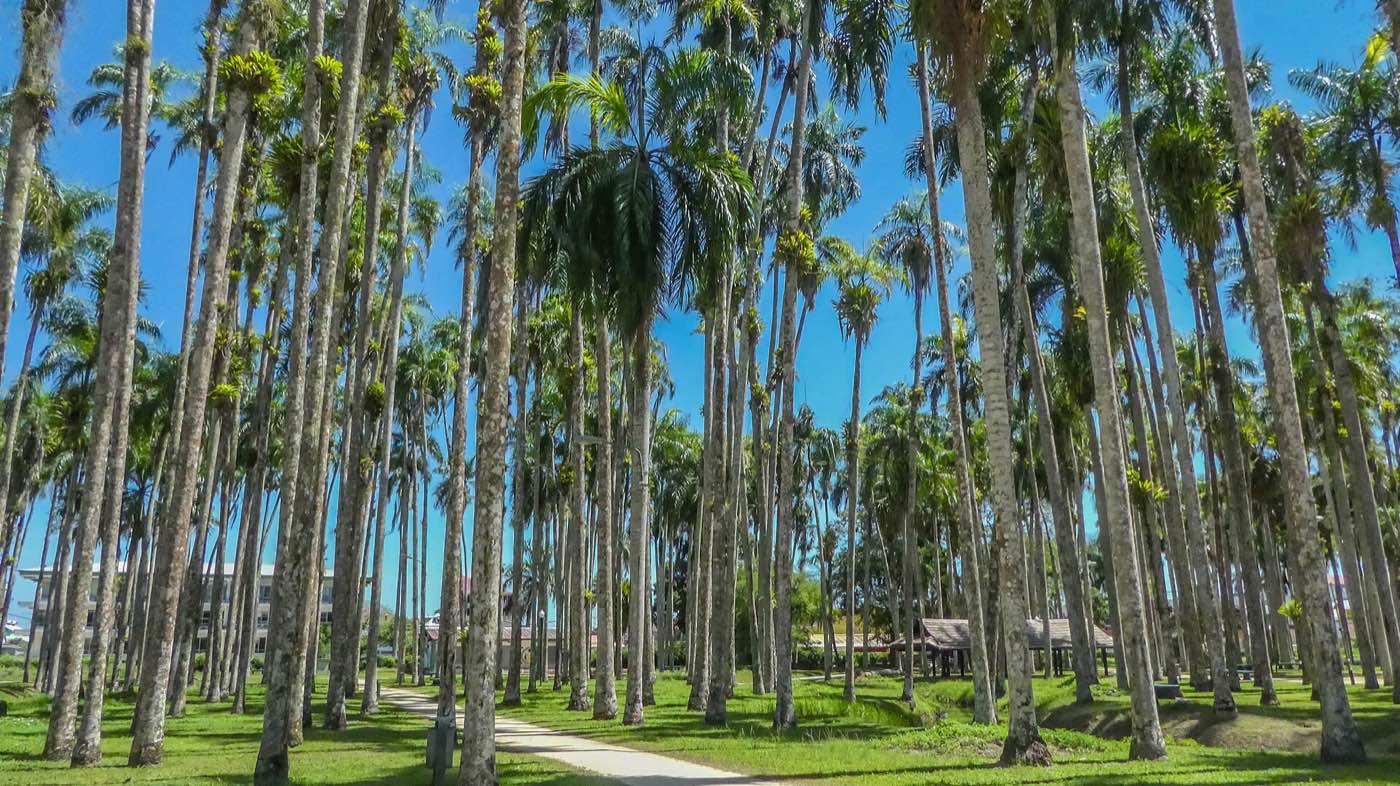
The Palmentuin — the Garden of Palms — is the public park at Grote Combeweg 6, immediately behind the Presidential Palace and adjoining Onafhankelijkheidsplein. It carries heritage status as a historic park.
Its usefulness on a walking route is positional: it sits directly between the square, the palace and Zus & Zo on the Grote Combeweg side, so it is the natural place to stop and sit in the middle of a morning in the inner city.
One caution worth taking seriously. The UK Foreign, Commonwealth and Development Office names Palm Garden among the secluded spots in and around Paramaribo where incidents including robbery have occurred. Treat it as a daytime, company-preferred place rather than somewhere to wander alone at dusk.
What we cannot tell you is nearly as long as what we can. The park's size, its opening hours, whether it is gated after dark, which palm species are planted, and the frequently repeated claim about capuchin monkeys in the trees are all unverified. Its map pin should be treated as approximate: the coordinates available to us are rounded to about a kilometre of precision on longitude.
A workable three-day plan: the UNESCO inner city on foot, a day across the river in Commewijne, and a third day that depends on what you want from Suriname.
Updated 21 August 2026
A half-day route through the thirty hectares UNESCO inscribed in 2002 — fort, square, palace, park, cathedral, and the synagogue and mosque that share a street.
Updated 21 August 2026
A 17th-century Dutch pentagonal fortress on the Suriname River bank in central Paramaribo, now housing the Stichting Surinaams Museum with colonial-period collections and period rooms.
The historic centre of Paramaribo is a UNESCO World Heritage site inscribed in 2002, covering a former Dutch colonial town of the 17th and 18th centuries whose original street plan and over 250 monuments survive.
A large mosque on Keizerstraat in central Paramaribo, in its present form dating from 1984, standing immediately next to the Neveh Shalom Synagogue.
Last verified
Information on this page is sourced from Wikidata, UK Foreign, Commonwealth and Development Office.